Showing posts with label Constellation Images. Show all posts

Saturday, March 16, 2024

Hydrus and Tucana Constellations

Hydrus and Tucana constellation star map — Amazing Astronomy website

Two Southern Hemisphere constellations are situated between the Small Magellanic Cloud: Hydrus the Water Snake and Tucana the Toucan. Hydrus is surrounded by 7 constellations: Dorado the Swordfish, Eridanus the River, Horologium the Clock, Mensa the Table Mountain, Octans the Octant, Reticulum the Reticule, and Tucana. Tucana is surrounded by 5 constellations: Grus the Crane, Hydrus, Indus the Indian, Octans, and Phoenix the Phoenix. Pavo the Peacock is another bird and constellation in the vicinity of Tucana.

GALAXIES in Hydrus: NGC 646, 802, 813, 1473, and 1511
GALAXIES in Tucana: NGC 53, 292, 360, 406, 432, 434, 440, 466, 484, 7205, 7219, 7278, 7329, 7359, 7408, 7417, 7650, 7652, 7657, 7661, 7676, 7697, 7733, 7734, and 7823

BRIGHTEST STAR in Hydrus: Beta Hydri (β), 2.80-2.84 apparent magnitude
BRIGHTEST STAR in Tucana: Alpha Tucanae (α), 2.87-2.89 apparent magnitude

STAR CLUSTERS in Hydrus: NGC 602, 643, 796, 1466, and 1629

GLOBULAR STAR CLUSTERS in Tucana: 47 Tucanae (NGC 104), NGC 121, 152, 265, 339, 361, 362, 416, and 419

OPEN STAR CLUSTERS in Tucana: NGC 176, 220, 222, 231, 242, 290, 330, 371, and 465

EMISSION NEBULAE in Tucana: NGC 248, 249, 261, 294, and 456

Tuesday, March 15, 2022

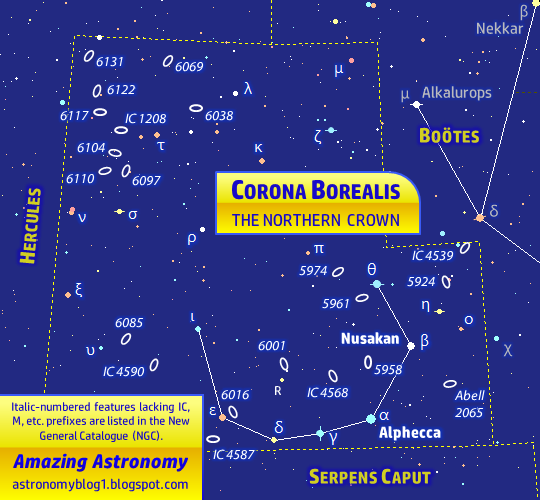
Corona Borealis Constellation Map

Greetings! There is a new constellation map of CORONA BOREALIS the Northern Crown. Created by me at Amazing Astronomy, the new image features plenty of galaxies; if you have a decent telescope, see if you can find some (or all?) of these cosmic wonders! View the Corona Borealis post (↗) to see the map!

Friday, May 15, 2020

Cygnus and Lacerta Constellation Map


Above is a new constellation image I drew recently this year. It features CYGNUS the Swan, a sprawling constellation known for straddling the Milky Way galaxy's star-studded band in the night sky. LACERTA the Lizard may not be as notable in the night sky, but the zigzagged constellation offers a few notable cosmic wonders.

Discover more about Cygnus with my blog post! Amazing Astronomy will post about Lacerta at a later date, keeping with the alphabetical order of constellation posts.

Saturday, August 10, 2019

Hydra Constellation

Hydra constellation star map — Amazing Astronomy website
Click the constellation map above to enlarge it in a lightbox window.

Like the previous constellation (Horologium) featured in an Amazing Astronomy post, HYDRA the Sea Serpent is not a notably visible constellation. Even so, the sea serpent impressively stretches across a vast 100-degree portion of the night sky and is therefore the largest constellation. Additionally, Hydra can make the claim of having a decent number of deep-sky objects. Visible from both the northern and southern hemispheres on Earth, Hydra borders a whopping 14 constellations: Antlia, Cancer, Canis Minor, Centaurus, Corvus, Crater, Leo, Libra, Lupus, Monoceros, Puppis, Pyxis, Sextans, and Virgo. Look at all those galaxies listed below ... and this is not a fully comprehensive list!

GALAXIES: NGC 2713, 2781, 2784, 2811, 2835, 2935, 2962, 2967, 2986, 2989, 3078, 3091, 3109, 3145, 3200, 3402, 3511, 3513, 3585, 3621, 3904, 3923, 4105, 4106, 5061, 5078, 5085, 5101, Abell 1060 Hydra Cluster (over 150 galaxies, including NGC 3309, 3311, and 3312), and Southern Pinwheel Galaxy (M83 and NGC 5236)

BRIGHTEST STAR: Alphard (Alpha Hydrae) (α), 1.98 apparent magnitude

2ND-BRIGHTEST STAR: Gamma Hydrae (γ), 3.00 apparent magnitude

GLOBULAR STAR CLUSTERS: Messier 68 (NGC 4590) and NGC 5694

OPEN STAR CLUSTER: Messier 48 (NGC 2548)

PLANETARY NEBULAE: Abell PK303 +40.1, Diamond Ring Nebula (Abell 33), and Ghost of Jupiter Nebula (NGC 3242)

VARIABLE STARS: AK Hydrae, IN Hydrae, R Hydrae, U Hydrae, and Y Hydrae

Sunday, November 12, 2017

Horologium Constellation


Horologium Constellation Map — Amazing Astronomy website

Originally named Horologium Oscillitorium by French astronomer Abbé Nicolas Louis de Lacaille in 1752, HOROLOGIUM the Clock was named in honor of the pendulum clock, invented in 1656 by Dutch astronomer and inventor Christiaan Huygens. This Southern Hemisphere constellation is quite difficult to see even with clear skies but is known for its vast array of galaxies and several notable variable stars. Neighboring constellations include Caelum, Dorado, Eridanus, Hydrus, and Reticulum.

Home to over 300,000 total galaxies, the Horologium Supercluster gives advanced-telescope users the chance to witness over 30 galaxies with visible magnitudes of 17 or brighter (lower). Prominent galaxies in Horologium include NGC (New Messier Catalogue) 1433, NGC 1448, and NGC 1512. According to the Constellation Guide website (↗), exoplanets are known to orbit three stars in Horologium as of the year 2017: Iota Horologii (ι), HD 27631, and TYC 8068-01208-1 (WASP-120). Iota Horologii is marked with a Greek letter ι (iota) in the constellation map above, while HD 27631 and TYC 8068-01208-1 are located near Alpha Horologii (α) in the northwestern section of Horologium. Variable star R Horologii (HD 18242) is known for displaying one of the widest ranges of brightness of all stars in the night sky. R Horologii's apparent or visible magnitude varies from about 4.00 to 14.30.


Image Credit
A3128 of the Horologium Supercluster: An Atlas of the Universe (↗)

Brightest Star: Alpha Horologii (α), 3.85 or 3.86 apparent magnitude

2nd-Brightest Star: R Horologii, 4.00-14.30 apparent magnitude
or Delta Horologii (δ), 4.93 apparent magnitude

Galaxies: Horologium Supercluster (~300,000 deep-sky galaxies, dozens visible from Earth), NGC 1249, NGC 1411, NGC 1433, NGC 1448, NGC 1493, and NGC 1512

Globular Star Cluster: NGC 1261

Variable Stars: R Horologii, TW Horologii, and V Horologii

Sunday, October 29, 2017

Hercules Constellation Map

Constellation map or sky chart of Hercules and surrounding constellations
Above is a new constellation image I finished on October 29th, 2017. It features HERCULES the Hero, a mighty vast constellation usually visible in the Northern Hemisphere. Let me know what you think about this map/sky chart in the comments section ... thanks!

Discover more about Hercules with my blog post!

Thursday, March 30, 2017

Hercules Constellation

Constellation map or sky chart of Hercules and surrounding constellations

Symbol of Hercules, derived from the illustrative work of Denis Moskowitz and Alec Finlay at Suberic.netMicrosoft Clip Art of the Hercules constellation
In proximity to the dense Milky Way band that is visible from Earth, HERCULES the Hero — the Roman name for the same Heracles character in Greek mythology — is a predominantly Northern Hemisphere constellation named after Jupiter's (Greek mythology: Zeus') heroic son. Hercules is the night sky's fifth-largest constellation and is one of 48 constellations to be listed by Ptolemy in his Almagest astronomical treatise. This vast constellation is surrounded by the following constellations: Aquila, Boötes, Corona Borealis, Draco, Lyra, Ophiuchus, Sagitta, Serpens Caput, Ursa Major, and Vulpecula.

Exoplanets seem to be discovered every day, and Hercules is home to at least twelve (12) confirmed stars with planets encircling them as of 2017. Two globular star clusters dominate over most other deep-sky objects within Hercules. Visible to the naked eye at apparent magnitude 5.8, Messier 13 (M13 and NGC 6205) boasts the designation of being the Northern Hemisphere's brightest globular cluster. This NASA Astronomy Picture of the Day (↗) reveals M13's brilliant blue, green, white, and yellow stars. Another daily photo (↗) depicts Comet Garradd traversing in February 2012 past Messier 92 (M92 and NGC 6341), Hercules' other prominent globular cluster. Other notable deep-sky wonders include the spiral-galaxy-filled Hercules Galaxy Cluster (Abell 2151), Abell 2199 galaxy cluster, Arp 272 interacting galaxies, circular Abell 39 planetary nebula, and NGC 6210 planetary nebula. More details about Hercules and its features can be found on the Constellation Guide website (↗).

Click on the images below to enlarge them to full size.

M13 globular star cluster, central area in the Hercules constellation       Hercules Cluster (Abell 2151) featuring mostly spiral galaxies

Hercules A radio source and its associated galaxy       NGC 6210 planetary nebula, located about 6,500 light years away in the southern section of Hercules

Image Credits (top-left, clockwise)
M13: NASA APOD (↗) — Marco Burali, Tiziano Capecchi, and Marco Mancini (Osservatorio MTM)
Hercules Cluster: NASA APOD (↗) — Ken Crawford
NGC 6210: Hubble Space Telescope (↗) — NASA and ESA
Hercules A: Hubble Space Telescope (↗) — NASA and ESA

Brightest Star: Kornephoros, Beta Herculis (β); 2.78 apparent magnitude

2nd-Brightest Star: Rasalgethi (Ras Algethi), Alpha Herculis (α); 2.78-3.35 apparent magnitude

Galaxies: Abell 2199 galaxy cluster (~300 galaxies), Hercules Cluster/Abell 2151 (~200 galaxies), Arp 272 interacting galaxies (IC 1179 and NGC 6050), and "supermassive" elliptical NGC 6166

Globular Star Clusters: Messier 13 (NGC 6205), Messier 92 (NGC 6341), and NGC 6229

Planetary Nebulae: Abell 39, IC 4593, and NGC 6210

Radio Source: Hercules A in the 3C 348 galaxy

Variable Stars: 30 Herculis, 68 Herculis, OP Herculis, U Herculis, and X Herculis
       — Binary Variable Star: Rasalgethi (Ras Algethi); three stars orbit each other, and one star is variable

Sunday, August 2, 2015

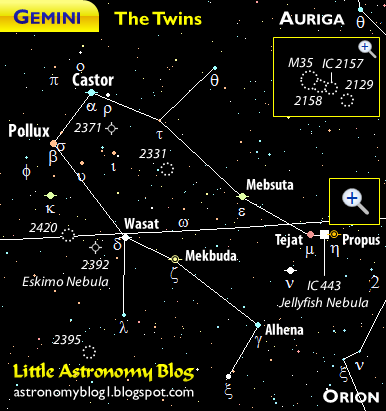
Gemini

Constellation map of Gemini the Twins

Zodiac symbol of Gemini
Straddling the Ecliptic and part of the dense Milky Way band, GEMINI the Twins is a Zodiac constellation visible to Northern Hemisphere stargazers in the summer and spring seasons and in the southern summer for Southern Hemisphere stargazers. The twins of Gemini are Castor and Pollux in Greek and Roman mythology. Castor and Pollux are also the names of Gemini's brightest and second-brightest stars, respectively. Gemini is surrounded by the constellations of Auriga, Cancer, Canis Minor, Lynx, Monoceros, Orion, and Taurus. While some constellations contain a great assortment of galaxies, Gemini does not because its location among densely clustered Milky Way stars prevents us from seeing galaxies in telescopes. Gemini does have notable open star clusters and nebulae. Messier 35 (M35) and NGC 2158 are next to each other in the night sky. As shown in this NASA Astronomy Picture of the Day (link opens in new tab or window), NGC 2158 is a dense star cluster while M35 is comprised of mostly blue stars in a loose cluster. The Eskimo Nebula (NASA APOD image), also known as NGC 2392 and Caldwell 39, is one of the most famous planetary nebulae for its interesting resemblance of an Eskimo's face with a surrounding parka hood! Another interesting planetary nebula is NGC 2371, located between the stars Castor and Iota (ι) Geminorum. Finally, the Jellyfish Nebula (IC 443) near the star Propus (Eta (η) Gem.) is a supernova remnant straddling the night sky's dense Milky Way band.

Brightest Star: Pollux ("very sweet"), Beta Geminorum (β); 1.14 apparent magnitude
Second-Brightest Star: Castor ("he who excels"), Alpha Geminorum (α); 1.58 app. m.
Binary Stars and Multi-Star Systems: Castor (six stars), Mebsuta (Epsilon (ε) Gem. - binary), Mekbuda*, Propus*, and Wasat (Delta (δ) Gem. - three stars)
* Mekbuda (Zeta (ζ) Gem.) is a binary system with a variable star, while Propus (Eta Gem, η) is a triple-star system with a variable star.
Open Star Clusters: IC 2157; M35; and New General Catalogue (NGC) objects: 2129, 2158, 2331, 2395, and 2420
Nebulae: planetary NGC 2371, planetary Eskimo Nebula (NGC 2392), and Jellyfish Nebula (IC 443) supernova remnant

Eridanus and Fornax

Constellation map of Eridanus and Fornax. Click to see the image's original size.
Click on the constellation map above to enlarge it in a lightbox window.

ERIDANUS the River and FORNAX the Furnace have completely different sizes - Eridanus being large and Fornax being small. In the celestial latitude system, Eridanus stretches from -5° to almost -60° while Fornax straddles the 30° mark. Both constellations share the fact that they are not truly Northern Hemisphere constellations, given that they are below the celestial equator. In the Earth's Northern Hemisphere, Eridanus' northern section can be mainly found during the winter season near the bright Orion constellation, located to the left of northern Eridanus. Caelum, Columba, Dorado, Horologium, and Lepus are other constellations to the left of Eridanus. Cetus and Phoenix are right of Eridanus and Sculptor is right of Fornax.

Countless Cosmic Wonders, Mostly Galaxies
The minuscule (or miniscule, whichever spelling you prefer!) Fornax - in regards to its official borders set by astronomers - actually has many more prominent and bright galaxies than Eridanus does. Fortunately for The River constellation, it has an amazing assortment of galaxies, many of which are not shown on the map above. First, the Fornax Cluster of galaxies in Fornax's western region is very close to Eridanus. Second, Eridanus has two main galaxy groupings called the Eridanus Group and Eridanus Cluster, both of which are north of Fornax's cluster. While these galaxies are not as bright as Fornax's, there are about 400 total galaxies in these two groups! Eridanus' NGC 1232 is a spectacular spiral galaxy in the Eridanus Cluster, while NGC 1291 south of Fornax is an interesting ring galaxy.

While someone could talk all day about the galaxies of Eridanus and Fornax, there are also planetary nebulae to talk about! Fornax has NGC 1360, a planetary nebulae nicknamed Robin's Egg Nebula. This image © Adam Block and The Planetary Society (link opens in new window) easily shows why the beautifully blue nebula has its nickname. NGC 1535 (University of Arizona Science Center image) left of Zaurak (Gamma Eridani, γ) in northern Eridanus was discovered by William Herschel.

ERIDANUS
Brightest Star: Achernar (end of the river), Alpha Eridani (α); 0.45 apparent magnitude
Binary Stars: Acamar (Theta Eridani, θ) and Tau 4 Eridani (τ^4)
Galaxies: NGC 1179, 1187, 1232, 1291, 1300, 1332, 1395, 1407, 1532, 1723, and many more
Planetary Nebula: NGC 1535

FORNAX
Brightest Star: Alpha Fornacis (α); 3.82 apparent magnitude
Binary Stars: Alpha Fornacis (α) and Beta Fornacis (β)
Galaxies: Fornax Dwarf Galaxy, NGC 1201, 1255, 1371, 1385, 1398, and more
          Fornax Cluster galaxies: NGC 1316, 1380, 1344, 1399, 1425, and more
Planetary Nebula: Robin's Egg Nebula (NGC 1960)

Monday, July 6, 2015

Equuleus

Equuleus the Foal constellation map imageWhile Draco is one of the largest constellations in the night sky, EQUULEUS the Foal is the second-smallest constellation after Crux the Southern Cross. Like Draco, stargazers barely see this dim Northern Hemisphere constellation. As shown in the Little Astronomy Blog constellation map above, Equuleus is surrounded by three constellations: Aquarius, Delphinus (another small constellation), and Pegasus. Since Pegasus the Winged Horse is found to the left of Equuleus, the Foal is sometimes represented as Pegasus' foal. Several notable yet hard-to-find galaxies exist in Equuleus, including NGC 7015, NGC 7046, and others listed below. WikiSky.org is a comprehensive source for astronomy information and imagery. With its help, I was able to find rare galaxy images of NGC 7015 and NGC 7046. In addition, its interactive cosmic map allowed me to create one of the most detailed constellation maps of Equuleus on the Internet! HD 200964 is a star with at least two planets nearby, while NGC 7045 is a binary star system. Equuleus' brightest star is Kitalpha (Alpha Equulei, α) with an apparent magnitude of about 3.92. According to WolframAlpha (link opens in new tab or window), Equuleus' stars exhibit a rather small range of temperatures, especially compared to stars in constellations like Draco. Heating up at 5,800° Kelvin, Kitalpha has the lowest temperature of Equuleus' main stars, while Beta Equuleus (β) boasts the highest temperature at 8,700° K.

NGC 7015 spiral galaxy in Equuleus NGC 7046 spiral galaxy in Equuleus

Brightest Star: Kitalpha ("part of the horse"; Alpha Equulei)
Double Star: NGC 7045
Star with Planets: HD 200964 in southeastern Equuleus
Galaxies: NGC 7015 (spiral), NGC 7040 (spiral), NGC 7046 (spiral), PGC 1239694 (immediately northwest of NGC 7046), and PGC 214759 (immediately west of NGC 7015)

Tuesday, June 2, 2015

Draco

Draco the Dragon constellation mapDRACO the Dragon is a large, winding constellation found in the Northern Hemisphere sky. It is generally difficult to find. As shown in the Little Astronomy Blog constellation map above, Draco is surrounded by seven constellations: Boötes, Cepheus, Cygnus, Hercules, Lyra, Ursa Major, and Ursa Minor. Draco is famous for a mesmerizing New General Catalogue object: the Cat's Eye Nebula. Categorized as NGC 6543, this planetary nebula features a dying star in the center with concentric shells of dust. Another interesting cosmic object is dwarf spiral galaxy NGC 6503, located near the star Psi (ψ) Draconis. This NASA webpage (opens in new tab or window) mentions that stargazer Stephen James O’Meara nicknamed this galaxy the Lost-in-Space Galaxy due to its location in the Local Void, an area where NGC 6503 is alone and far away from other galaxies. Draco's brightest star is Etamin (Gamma Draconis, γ) with an apparent magnitude of about 2.24. Etamin is also known as Eltanin and is described as "the dragon's head." Other bright stars include Aldhibain (Eta Draconis, η), Rastaban (Beta Draconis, β; also known as Alwaid), and Altais (Delta Draconis, δ). According to WolframAlpha (link opens in new tab/window), Draco's stars exhibit a wide range of temperatures. With a temperature of about 5000° Kelvin, Giausar (Lambda Draconis, λ) has one of the lowest temperatures in Draco. In contrast, stars such as Nodus I (Zeta Draconis, ζ) and Kappa (κ) Draconis heat up about three times more than Giausar at 15,000° K! NASA Astronomy Picture of the Day (APOD) image links - the yellow text below - automatically open in new tabs or windows.

Brightest Star: Etamin (also known as Eltanin and γ Draconis)
Binary (Double) Stars: Aldhibain, Epsilon Draconis (ε), Mu Draconis (μ), Nu Draconis (ν), and Psi Draconis (ψ)
Variable Stars: AT Draconis, RY Draconis, and VW Draconis
Galaxies: New General Catalogue objects: 4125, 4236, 4589, 4750, Spindle Galaxy (NGC 5866 and M102), 5879, 5907, Draco Group (trio comprised of 5981, 5982, and 5985), 6015, and 6503
Planetary Nebula: Cat's Eye Nebula

Tuesday, May 5, 2015

Delphinus

Delphinus constellation map
A small yet relatively bright constellation in the night sky, DELPHINUS the Dolphin is mainly a Northern Hemisphere constellation best seen in the summer season. Cygnus the swan, the previous constellation post on The Little Astronomy Blog, is in the same geographic vicinity as Delphinus. Geographically speaking, Delphinus is typically seen northeast of Aquarius the water carrier, west of Aquila the eagle and Sagitta the arrow, south of Cygnus and Vulpecula the fox, east of Equuleus the little horse (foal) and Pegasus the flying horse. The constellation image of Delphinus is comprised of five main stars. The brightest star is Rotanev, shining in the dolphin's torso with an apparent magnitude slightly over 3.60. As written below, Delphinus features multiple deep-sky objects such as nebulae, galaxies, and globular star clusters. One interesting celestial sight in Delphinus is ZW II 96, in which two young galaxies are merging. This and other ZW-designated celestial objects are part of the Zwicky Catalogue of Galaxies.

Brightest Star: Rotanev (Beta Delphini, β)
Second Brightest Star: Sualocin (Alpha Delphini, α)
Interesting Stars: Gamma (γ) Delphini (binary star comprised of a yellow-white dwarf star and an orange subgiant star) and U Delphini (pulsating variable)
Galaxy Merger: ZW II 96
Planetary Nebulae: NGC 6891 (NASA APOD image - link opens in new window/tab) and NGC 6905 (Blue Flash Nebula)
Globular Star Clusters: NGC 6934 and NGC 7006

Base Map derived from Planetarium (software), version 1.8 (© 1998 JC Research, Toxsoft).

Monday, July 21, 2014

Crux

Map image of Crux the Southern Cross constellation
CRUX the Southern Cross may be a small constellation, but it certainly is spectacular! Astronomers and stargazers around the world often consider Crux one of the most wonderful constellations due to its brightness and many cosmic objects. The constellation Centaurus surrounds Crux in the west, north, and east; Musca is south of Crux. The Coal Sack Nebula is by far the largest remarkable object in Crux. Extending into Centaurus and Musca, the Coal Sack Nebula is famous for its dark black appearance amid star-studded surroundings. The Jewel Box Cluster (4755 in the New General Catalogue) is truly a cosmic gem, possessing a colorful variety of stars as an open star cluster. Crux is an important cultural element; for example, it is featured on the flags of Australia, Brazil, New Guinea, Papua New Guinea, and Samoa.
Brightest Star: Acrux (Alpha Crucis, α)
Second Brightest Star: Mimosa (Beta Crucis, β)
Nebula: Coal Sack Nebula (Caldwell Catalogue 99, C99)
Star Clusters: H5, NGC 4103, NGC 4349, NGC 4439, NGC 4609, and Jewel Box Cluster (NGC 4755); NGC 4463 and NGC 4815 are in Musca
All yellow links above open up to images from the Students for the Exploration and Development of Space (SEDS).

Sunday, July 20, 2014

Circinus Constellation Map

Map image of Circinus the Compasses, a constellation
Above is a new constellation image I created. It features CIRCINUS the Drawing Compasses (or Compass), a rather dim and obscure constellation in the Southern Hemisphere.

Discover more about Circinus with my blog post!

Thursday, March 13, 2014

Corvus & Crater

CORVUS the Crow and CRATER the Cup are two small, neighboring constellations. From a Northern Hemisphere perspective, Corvus is west of Crater. Both constellations are north of an extremely long, dim constellation called Hydra; they are also south of Virgo, while Crater is southwest of another small constellation: Sextans. There are several galaxies and other interesting cosmic phenomena in Corvus and Crater. The spectacular Antennae Galaxies in Eastern Corvus (comprised of galaxies NGC 4038 and NGC 4039) are famous in astronomy because the two galaxies are colliding beautifully and forming one large galaxy. Illustrated by Roen Kelly, both constellation maps below are from the Astronomy Magazine's website (astronomy.com).

Corvus constellation map — Astronomy.com image

CORVUS
Brightest Star: Gienah (Gamma γ Corvi)
Second Brightest Star: Kraz (Beta β Corvi)
Galaxies: Antennae Galaxies*, NGC 4027^, and NGC 4802.
Planetary Nebula: NGC 4361*

* - National Optical Astronomy Observatory (USA) photos
^ - Australian Astronomical Observatory photo

Crater constellation map — Astronomy.com image

CRATER
Brightest Star: δ Crateris (3.6 apparent magnitude)
Second Brightest Star: γ Crateris (4.1 apparent magnitude)
Galaxies: NGC 3511, NGC 3513, NGC 3672, NGC 3887, and NGC 3962

Corona Borealis

CORONA BOREALIS, also known as the Northern Crown, is a small but noticeable constellation forming a semicircular 'crown' with seven main stars. It is prominently visible in the Northern Hemisphere's Spring and Summer seasons, while it is harder to find in the Fall and Winter skies. In the Southern Hemisphere, Corona Borealis is only visible near the horizon in the northern sky, during the seasons of Fall and Winter (Spring and Summer in the Northern Hemisphere). From the Northern Hemisphere perspective, the constellation is west of Boötes (an easily identifiable constellation with a bright star, Arcturus), south and east of Hercules, and north of Serpens Caput (the eastern part of Serpens, which symbolizes a snake's head). Alphekka (Alphecca) is Corona Borealis' brightest star with an apparent magnitude brightness ranging from 2.21 to 2.32, and Nusakan is the second brightest (3.7).

Interesting Fact: Several exoplanets — planets that are outside of our Solar System — have been discovered in Corona Borealis' region!

Wednesday, August 28, 2013

Columba

COLUMBA the Dove is a small constellation that can be seen in the night skies of both Northern and Southern Hemispheres. It is west of Caelum, southeast of Canis Major (the Big Dog), south of Lepus, north of Pictor, and east of Puppis. The brightest star is named Phact; it is also called Alpha (α) Columbae and has an apparent magnitude of 2.65. Wazn, also known as Beta (β) Columbae, is the second brightest at magnitude 3.2. Ignoring the convention of the Gamma star being the third brightest in many constellations, Delta (­δ) Columbae is the third brightest with a magnitude of 4. NGC 1851 is a spectacular globular star cluster to the east of the constellation.

Monday, August 26, 2013

Circinus

Map image of the constellation Circinus
CIRCINUS the Compass is a faint, small constellation in the Southern Hemisphere's night sky. While not all that spectacular, it does contain several somewhat bright stars and is located near more famous constellations. It is considered a compass not because it looks like the circular-shaped compass used to find directions, but it looks like the device (also called calipers) used to draw arcs and circles. Circinus is located to the north of Apus, southwest of Centaurus, south of Lupus, west of Musca, southeast of Norma, and east of Triangulum Australis. If you live in the Southern Hemisphere, find Circinus by finding out where to look for a bright star known as Rigil Kentaurus, in the southern part of the constellation Centaurus, and look to the left. Circinus' brightest star (α) is Alpha Circini with an apparent magnitude of 3.18, while the second brightest star (β) is Beta Circini with a magnitude of 4.2. Gamma (­γ) Circini is the third brightest star (magnitude 4.5) and the third star to form the compass shape.

Tuesday, July 16, 2013

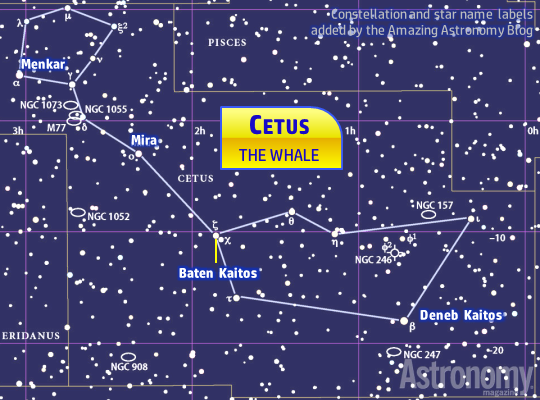
Cetus

A large constellation for sure, CETUS the Whale (or Sea Monster) can be spotted from both the Northern and Southern Hemispheres on Earth. In the sky, Cetus is found north of the constellations Fornax and Sculptor, south of Aries and Pisces, southeast of Taurus, east of Eridanus, and west of Aquarius. Use a very bright constellation, Orion, as a reference to find Cetus, which is located east of Orion (you would cross a northern section of Eridanus before finding Cetus). Cetus is not very bright, but it does contain an assortment of galaxies and planetary nebulae. Two notable galaxies are M77 and NGC 246 (nicknamed the Pacman Nebula), and several other examples of galaxies categorized in the New General Catalogue (NGC) include NGC 247, 428, 936, 1042, and 1052, among others. The brightest star is usually the alpha star (designated with an α symbol), but the beta star (β) in Cetus is actually the brightest! The brightest star is Deneb Kaitos with a magnitude of around 2.02, while the second bright star is Menkar with a magnitude of 2.53.

Friday, July 20, 2012

Cassiopeia & Cepheus

Straddling along the spectacular Milky Way Band, CASSIOPEIA the Queen (left in image) & CEPHEUS the King (right in image) are certainly a royal and star-studded couple! A variety of star bodies can be found in both, including plenty of open star clusters in Cassiopeia, a few galaxies (three of them, NGC 278, 147, & 185, are more south of Cassiopeia than what the image shows), and beautiful nebulae. While Cassiopeia is known for famous nebulae, like Pacman Nebula and Bubble Nebula, Cepheus boasts a few interesting stars. One of them is the Garnet Star (μ), a large supergiant noted for its deep red color; another is Delta (δ) Cephei, a Cepheid variable star in which brightness changes as it pulsates. In addition, Cepheus has quite a collection of spectacular nebulae as well, like the luminous Iris Nebula, vast Elephant's Trunk Nebula (IC 1396), and neat Bow-Tie Nebula (NGC 40 - planetary nebula)! You'll find Andromeda, Cygnus, Lacerta, & Perseus south of Cassiopeia & Cepheus, while Draco is east of Cepheus, Camelopardalis is west of Cassiopeia, and Polaris (at the tip of Ursa Minor, the Little Dipper) is north of Errai (the 'crown' star in Cepheus).
This image reveals the major stars in Cassiopeia, which form the iconic 'W'CASSIOPEIA
Brightest Star: Schedar, also known as Shedir (average apparent magnitude of 2.24)
Second Brightest Star: Caph (2.28) (the lower the number, the brighter).
Some Remarkable Objects: Pacman Nebula, Bubble Nebula (NGC 7635), & Heart Nebula (IC 1805 - west of Cassiopeia & not shown on image)
CEPHEUS
Brightest Star: Alderamin (2.25)
Second Brightest Star: Alfirk (3.14)
Some Remarkable Objects: Garnet Star, Delta Cephei, Elephant's Trunk Nebula, & Iris Nebula (NGC 7023)
*All numbers in the image that don't have letters (M, IC, etc.) in front represent cosmic bodies that are categorized in the NGC - New General Catalogue

Blog Background

The background has three Hubble Space Telescope images:

— LH 95 is a star-forming region in the Large Magellanic Cloud, Dorado constellation.

— Ant Nebula (also called Menzel 3) is an aptly-named planetary nebula located in the constellation Norma.

— Egg Nebula (also called CL 2688) is a protoplanetary nebula in the constellation Cygnus.