Besides the twelve Zodiac constellations, which two constellations encompass the Sun's path? The two correct answers are listed further below!
A — Cetus (for approximately one day only: March 27)
B — Ophiuchus (approximately November 30 to December 18)
C — Crux (approximately May 15 to July 7)
ANSWER
A and B . . . . . Cetus and Ophiuchus

Virtually explore the universe with this blog — featuring galaxies, constellations, meteor showers, and more marvels!
Showing posts with label Constellations A-G. Show all posts
Showing posts with label Constellations A-G. Show all posts
Sunday, May 31, 2026

Wednesday, February 1, 2023
Green Comet in the Northern Sky
An infrequent visitor of our night sky has arrived and can be seen particularly in the Northern Hemisphere. Officially known as Comet C/2022 E3 (ZTF), the "Green Comet" was likely last seen on Earth approximately 50,000 years ago! The sparkly spectacle gets its hue from carbon in its gas cloud surrounding the nucleus. The comet can be generally spotted in the constellation CAMELOPARDALIS the Giraffe, a rather dimly lit circumpolar constellation situated in the northern sky near the "North Star," Polaris. If Camelopardalis is in your night sky, then the comet likely is, too. The comet should remain in Northern Hemisphere skies toward the northern direction until early or mid February. Visit the Weather Channel (↗), National Geographic (↗), PBS NewsHour (↗), etc. for more info.
Vimeo video credit: Miguel Claro
Vimeo video credit: Miguel Claro
Thursday, January 26, 2023
How Many Exoplanets?
According to NASA and Caltech’s Exoplanet Archive website (↗), there are over 5,000 confirmed exoplanets as of January 2023 and now 5,587 as of February 2024!
Famed astrophysicist Neil deGrasse Tyson also mentioned this fun fact on The Late Show With Stephen Colbert on September 22nd, 2022. Situated far away from our solar system planets, these exoplanets surround stars found in constellations including but definitely not limited to Andromeda, Aquarius, Aquila, Ara, Aries, Auriga, Boötes, Cancer, Canes Venatici, Canis Major, Cetus, Chamaeleon, Coma Berenices, Corona Borealis, Cygnus, Delphinus, Draco, Eridanus, Grus, Hercules, Hydrus, Indus, Leo, Lepus, Lupus, Lynx, Microscopium, Pegasus, Pictor, Pisces, Piscis Austrinus, Scorpius, Sextans, Taurus, Ursa Major, Ursa Minor, and Virgo.
Famed astrophysicist Neil deGrasse Tyson also mentioned this fun fact on The Late Show With Stephen Colbert on September 22nd, 2022. Situated far away from our solar system planets, these exoplanets surround stars found in constellations including but definitely not limited to Andromeda, Aquarius, Aquila, Ara, Aries, Auriga, Boötes, Cancer, Canes Venatici, Canis Major, Cetus, Chamaeleon, Coma Berenices, Corona Borealis, Cygnus, Delphinus, Draco, Eridanus, Grus, Hercules, Hydrus, Indus, Leo, Lepus, Lupus, Lynx, Microscopium, Pegasus, Pictor, Pisces, Piscis Austrinus, Scorpius, Sextans, Taurus, Ursa Major, Ursa Minor, and Virgo.
Thursday, March 30, 2017
48 Constellations of Ptolemy
Amazing Astronomy — 2nd-century writer, astronomer, astrologer, geographer, and mathematician Claudius Ptolemy compiled a treatise spelling out over 1,000 major stars and 48 prominent constellations in the night sky. Over 1,000 years later, his Almagest (Almagestum) material was first published in the year 1515 in Venice (Italy), in the Latin language, and by Petrus Lichtenstein. Including the original Greek constellation names, the following is an alphabetical list of Ptolemy's forty-eight constellations:
ANDROMEDA — Ἀνδρομέδα
AQUARIUS — Ὑδροχόος (Hydrochoös)
AQUILA — Ἀετός (Aetos)
ARA — Θυμιατήριον (Thymiaterion)
ARGO (present-day CARINA, PUPPIS, and VELA) — Ἀργώ
ARIES — Κριός (Krios)
AURIGA — Ἡνίοχος (Heniochos)
BOÖTES — Βοώτης
CANCER — Καρκίνος (Karkinos)
CANIS MAJOR — Κύων (Kyon)
CANIS MINOR — Προκύων (Prokyon)
CAPRICORNUS — Αἰγόκερως (Aigokeros)
CASSIOPEIA — Κασσιέπεια
CENTAURUS — Κένταυρος
CEPHEUS — Κηφεύς
CETUS — Κῆτος
CORONA AUSTRALIS — Στέφανος νότιος (Stephanos Notios)
CORONA BOREALIS — Στέφανος (Stephanos)
CORVUS — Κόραξ (Korax)
CRATER — Κρατήρ
CYGNUS — Ὄρνις (Ornis)
DELPHINUS — Δελφίν (Delphin)
DRACO — Δράκων (Drakon)
EQUULEUS — Ἵππου προτομή (Hippou Protome)
ERIDANUS — Ποταμός (Potamos)
GEMINI — Δίδυμοι (Didymoi)
HERCULES — Ἐνγόνασι (Engonasi)
HYDRA — Ὕδρος (Hydros)
LEO — Λέων
LEPUS — Λαγωός (Lagoös)
LIBRA — Χηλαί (Chelae)
LUPUS — Θηρίον (Therion)
LYRA — Λύρα
OPHIUCHUS — Ὀφιοῦχος
ORION — Ὠρίων
PEGASUS — Ἵππος (Hippos)
PERSEUS — Περσεύς
PISCES — Ἰχθύες (Ichthyes)
PISCIS AUSTRINUS — Ἰχθύς νότιος (Ichthys Notios)
SAGITTA — Ὀιστός (Oistos)
SAGITTARIUS — Τοξότης (Toxotes)
SCORPIUS — Σκορπίος
SERPENS — Ὄφις (Ophis)
TAURUS — Ταῦρος
TRIANGULUM — Τρίγωνον (Trigonon)
URSA MAJOR — Ἄρκτος μεγάλη
URSA MINOR — Ἄρκτος μικρά
VIRGO — Παρθένος (Parthenos)
The original 1515-era publication — PDF files may take awhile to load — can be viewed on this Universität Wien (University of Vienna) webpage (↗).
ANDROMEDA — Ἀνδρομέδα
AQUARIUS — Ὑδροχόος (Hydrochoös)
AQUILA — Ἀετός (Aetos)
ARA — Θυμιατήριον (Thymiaterion)
ARGO (present-day CARINA, PUPPIS, and VELA) — Ἀργώ
ARIES — Κριός (Krios)
AURIGA — Ἡνίοχος (Heniochos)
BOÖTES — Βοώτης
CANCER — Καρκίνος (Karkinos)
CANIS MAJOR — Κύων (Kyon)
CANIS MINOR — Προκύων (Prokyon)
CAPRICORNUS — Αἰγόκερως (Aigokeros)
CASSIOPEIA — Κασσιέπεια
CENTAURUS — Κένταυρος
CEPHEUS — Κηφεύς
CETUS — Κῆτος
CORONA AUSTRALIS — Στέφανος νότιος (Stephanos Notios)
CORONA BOREALIS — Στέφανος (Stephanos)
CORVUS — Κόραξ (Korax)
CRATER — Κρατήρ
CYGNUS — Ὄρνις (Ornis)
DELPHINUS — Δελφίν (Delphin)
DRACO — Δράκων (Drakon)
EQUULEUS — Ἵππου προτομή (Hippou Protome)
ERIDANUS — Ποταμός (Potamos)
GEMINI — Δίδυμοι (Didymoi)
HERCULES — Ἐνγόνασι (Engonasi)
HYDRA — Ὕδρος (Hydros)
LEO — Λέων
LEPUS — Λαγωός (Lagoös)
LIBRA — Χηλαί (Chelae)
LUPUS — Θηρίον (Therion)
LYRA — Λύρα
OPHIUCHUS — Ὀφιοῦχος
ORION — Ὠρίων
PEGASUS — Ἵππος (Hippos)
PERSEUS — Περσεύς
PISCES — Ἰχθύες (Ichthyes)
PISCIS AUSTRINUS — Ἰχθύς νότιος (Ichthys Notios)
SAGITTA — Ὀιστός (Oistos)
SAGITTARIUS — Τοξότης (Toxotes)
SCORPIUS — Σκορπίος
SERPENS — Ὄφις (Ophis)
TAURUS — Ταῦρος
TRIANGULUM — Τρίγωνον (Trigonon)
URSA MAJOR — Ἄρκτος μεγάλη
URSA MINOR — Ἄρκτος μικρά
VIRGO — Παρθένος (Parthenos)
The original 1515-era publication — PDF files may take awhile to load — can be viewed on this Universität Wien (University of Vienna) webpage (↗).
Wednesday, September 28, 2016
Brightest Star in Every Constellation
The following Little Astronomy Blog post comprehensively lists every brightest star for each of the 88 constellations! Each star's name is listed in parentheses next to its respective constellation, followed by the apparent magnitude — visibility to the human eye. Values come from WolframAlpha.
Andromeda — Alpheratz (2.07)
Antlia — α Antliae (4.28)
Apus — α Apodis (3.83)
Aquarius — Sadalsuud (2.87)
Aquila — Altair (0.76-0.77)
Ara — α Arae (2.84)
Aries — Hamal (2.01)
Auriga — Capella (0.08)
Boötes — Arcturus (-0.05)
Caelum — α Caeli (4.44)
Camelopardalis — β Camelopardalis (4.03)
Cancer — Al Tarf (Tarf) (3.53)
Canes Venatici — Cor Caroli (Asterion) (2.89)
Canis Major — Sirius, brightest star in the night sky (-1.44, -1.46)
Canis Minor — Procyon (0.4)
Capricornus — Deneb Algiedi (2.85)
Carina — Canopus, 2nd-brightest star in the night sky (-0.62 to -0.74)
Cassiopeia — usually Schedar (Shedir) (2.24)
...but sometimes Tsih (up to 1.6 and a minimum of 3.0)
Centaurus — α Centauri (Rigel Kent), 3rd-brightest star in the night sky (-0.01)
Cepheus — Alderamin (2.45)
Cetus — Deneb Kaitos ("whale's tail") (2.02-2.04)
Chamaeleon — α Chamaeleontis (4.05)
Circinus — α Circini (3.18-3.21)
Columba — Phact (2.65)
Coma Berenices — β Comae Berenices (4.23)
Corona Australis — Alphekka Meridiana & β Coronae Australis (both about 4.1)
Corona Borealis — Alphekka (Alphecca) (2.21-2.32)
Corvus — Gienah (2.58)
Crater — δ Crateris (3.56)
Crux — Acrux (0.77)
Cygnus — Deneb (1.21-1.29)
Delphinus — Rotanev (3.6)
Dorado — α Doradus (3.3)
Draco — Etamin (2.24)
Equuleus — Kitalpha (3.92)
Eridanus — Achernar (0.45)
Fornax — α Fornacis (3.8)
Gemini — Pollux (1.14, 1.16)
Grus — Alnair (1.73-1.74)
Hercules — Kornephoros (2.78)
Horologium — α Horologii (3.85)
Hydra — Alphard (1.99)
Hydrus — β Hydri (2.82)
Indus — α Indi (3.11)
Lacerta — α Lacertae (2.76-2.777)
Leo — Regulus (1.36)
Leo Minor — Praecipua (46 Leonis Minoris, HIP 53229) (3.79-3.83)
Lepus — Arneb (2.58)
Libra — Zubeneshamali (2.61)
Lupus — α Lupi (2.3)
Lynx — α Lyncis (3.14)
Lyra — Vega (0.03)
Mensa — α Mensae (5.08)
Microscopium — γ Microscopii (4.67)
Monoceros — β Monocerotis (3.76)
Musca — α Muscae (2.68-2.73)
Norma — γ2 Normae (4.01)
Octans — ν Octantis (3.73-3.76)
Ophiuchus — Rasalhague (2.08)
Orion — Rigel (0.18)
Pavo — Peacock (α Pavonis) (1.94)
Pegasus — Enif (usually 2.38, but varies from 0.7 to 3.5)
Perseus — Mirphak (1.79)
Phoenix — Ankaa (2.4)
Pictor — α Pictoris (3.24-3.3)
Pisces — η Piscium (3.62)
Piscis Austrinus — Fomalhaut (1.15-1.17)
Puppis — Naos (2.21-2.25)
Pyxis — α Pyxidis (3.68)
Reticulum — α Reticulii (3.33)
Sagitta — γ Sagittae (3.51)
Sagittarius — Kaus Australis (1.79-1.85)
Scorpius — Antares (0.88-1.16)
Sculptor — α Sculptoris (4.3)
Scutum — α Scuti (3.85)
Serpens — Unukalhai (2.62-2.63)
Sextans — α Sextantis (4.48)
Taurus — Aldebaran (0.87)
Telescopium — α Telescopii (3.49)
Triangulum — β Trianguli (3.0)
Triangulum Australe — Atria (1.91)
Tucana — α Tucanae (2.87)
Ursa Major — Alioth (1.76-1.78)
Ursa Minor — Polaris ("North Star") (1.97)
Vela — Regor (1.74)
Virgo — Spica (0.95-1.1)
Volans — β Volantis (3.77)
Vulpecula — α Vulpeculae (4.44)
Andromeda — Alpheratz (2.07)
Antlia — α Antliae (4.28)
Apus — α Apodis (3.83)
Aquarius — Sadalsuud (2.87)
Aquila — Altair (0.76-0.77)
Ara — α Arae (2.84)
Aries — Hamal (2.01)
Auriga — Capella (0.08)
Boötes — Arcturus (-0.05)
Caelum — α Caeli (4.44)
Camelopardalis — β Camelopardalis (4.03)
Cancer — Al Tarf (Tarf) (3.53)
Canes Venatici — Cor Caroli (Asterion) (2.89)
Canis Major — Sirius, brightest star in the night sky (-1.44, -1.46)
Canis Minor — Procyon (0.4)
Capricornus — Deneb Algiedi (2.85)
Carina — Canopus, 2nd-brightest star in the night sky (-0.62 to -0.74)
Cassiopeia — usually Schedar (Shedir) (2.24)
...but sometimes Tsih (up to 1.6 and a minimum of 3.0)
Centaurus — α Centauri (Rigel Kent), 3rd-brightest star in the night sky (-0.01)
Cepheus — Alderamin (2.45)
Cetus — Deneb Kaitos ("whale's tail") (2.02-2.04)
Chamaeleon — α Chamaeleontis (4.05)
Circinus — α Circini (3.18-3.21)
Columba — Phact (2.65)
Coma Berenices — β Comae Berenices (4.23)
Corona Australis — Alphekka Meridiana & β Coronae Australis (both about 4.1)
Corona Borealis — Alphekka (Alphecca) (2.21-2.32)
Corvus — Gienah (2.58)
Crater — δ Crateris (3.56)
Crux — Acrux (0.77)
Cygnus — Deneb (1.21-1.29)
Delphinus — Rotanev (3.6)
Dorado — α Doradus (3.3)
Draco — Etamin (2.24)
Equuleus — Kitalpha (3.92)
Eridanus — Achernar (0.45)
Fornax — α Fornacis (3.8)
Gemini — Pollux (1.14, 1.16)
Grus — Alnair (1.73-1.74)
Hercules — Kornephoros (2.78)
Horologium — α Horologii (3.85)
Hydra — Alphard (1.99)
Hydrus — β Hydri (2.82)
Indus — α Indi (3.11)
Lacerta — α Lacertae (2.76-2.777)
Leo — Regulus (1.36)
Leo Minor — Praecipua (46 Leonis Minoris, HIP 53229) (3.79-3.83)
Lepus — Arneb (2.58)
Libra — Zubeneshamali (2.61)
Lupus — α Lupi (2.3)
Lynx — α Lyncis (3.14)
Lyra — Vega (0.03)
Mensa — α Mensae (5.08)
Microscopium — γ Microscopii (4.67)
Monoceros — β Monocerotis (3.76)
Musca — α Muscae (2.68-2.73)
Norma — γ2 Normae (4.01)
Octans — ν Octantis (3.73-3.76)
Ophiuchus — Rasalhague (2.08)
Orion — Rigel (0.18)
Pavo — Peacock (α Pavonis) (1.94)
Pegasus — Enif (usually 2.38, but varies from 0.7 to 3.5)
Perseus — Mirphak (1.79)
Phoenix — Ankaa (2.4)
Pictor — α Pictoris (3.24-3.3)
Pisces — η Piscium (3.62)
Piscis Austrinus — Fomalhaut (1.15-1.17)
Puppis — Naos (2.21-2.25)
Pyxis — α Pyxidis (3.68)
Reticulum — α Reticulii (3.33)
Sagitta — γ Sagittae (3.51)
Sagittarius — Kaus Australis (1.79-1.85)
Scorpius — Antares (0.88-1.16)
Sculptor — α Sculptoris (4.3)
Scutum — α Scuti (3.85)
Serpens — Unukalhai (2.62-2.63)
Sextans — α Sextantis (4.48)
Taurus — Aldebaran (0.87)
Telescopium — α Telescopii (3.49)
Triangulum — β Trianguli (3.0)
Triangulum Australe — Atria (1.91)
Tucana — α Tucanae (2.87)
Ursa Major — Alioth (1.76-1.78)
Ursa Minor — Polaris ("North Star") (1.97)
Vela — Regor (1.74)
Virgo — Spica (0.95-1.1)
Volans — β Volantis (3.77)
Vulpecula — α Vulpeculae (4.44)
Monday, July 11, 2016
Grus, Phoenix, Piscis Austrinus, and Sculptor

Four neighboring Southern Hemisphere constellations — GRUS the Crane, PHOENIX the Phoenix, PISCIS AUSTRINUS the Southern Fish, and SCULPTOR the Sculptor — appear quite unremarkable compared to brighter, well-known constellations such as Crux. However, these constellations do at least contain a plethora of galactic wonders. Most of the identified deep-sky objects in this region are galaxies. Some constellation maps do not show any galaxies for Phoenix. Unlike the Little Astronomy Blog map above, these maps neglect to show that there are some recently discovered galaxies classified in the Principal Galaxies Catalogue (PGC); these elusive galaxies are farther away than galaxies in the other three constellations. While Grus, Phoenix, Piscis Austrinus, and Sculptor are said to be Southern Hemisphere constellations, they are immediately south of Cetus and the Zodiac constellations Aquarius and Capricornus. Therefore, Northern Hemisphere stargazers might see them near the horizon, especially in the southern sky during the late summer and fall seasons.
Galaxies, Globular Star Cluster, Galaxies, and More Galaxies!
 As mentioned above, these four constellations have plenty of galaxies. However, there are very few nebulae and star clusters. Piscis Austrinus' NGC 288 is arguably the most remarkable globular star cluster in the area. Shown in the photo to the left from Sky-Map.org's interactive map, IC 5148 (colloquially known as "Spare Tire Nebula") is a doughnut-like planetary nebula located near the Lambda (λ) Gruis star. Other than these wonders, galaxies take the crown! Remarkable examples include the Sculptor Dwarf Galaxy, NGC 300, NGC 613 in Sculptor (pictured above), NGC 7599 in Grus, IC 1627 in Phoenix, and NGC 7174 and 7314 in Piscis Austrinus.
GRUS
Brightest Star: Alnair, Alpha Gruis (α); 1.74 apparent magnitude
Galaxies: IC 1459, 5267, NGC 7496, and Grus Quartet: NGC 7552, 7582, 7590, and 7599
Planetary Nebula: IC 5148
PHEONIX
Brightest Star: Ankaa, Alpha Phoenicis (α); 2.4 apparent magnitude
Galaxies: IC 1627, PGC 725, 729, and 1855
PISCIS AUSTRINUS
Brightest Star: Fomalhaut, Alpha Piscis Austrini (α); 1.15 apparent magnitude
Galaxies: NGC 7172, 7174, 7176, 7221, and 7314
SCULPTOR
Brightest Star: Alpha Sculptoris (α); 4.3 apparent magnitude
Galaxies: IC 5332, NGC 24, 55, 134, 150, 253, 289, 300, 613, 7713, 7755, 7793, Sculptor Dwarf Galaxy, PGC 2248 (Cartwheel Galaxy), and more
Globular Star Cluster: NGC 288
Sunday, August 2, 2015
Gemini
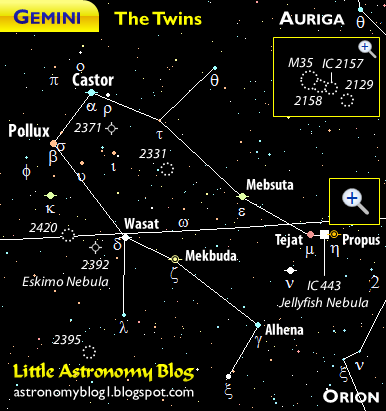

Brightest Star: Pollux ("very sweet"), Beta Geminorum (β); 1.14 apparent magnitude
Second-Brightest Star: Castor ("he who excels"), Alpha Geminorum (α); 1.58 app. m.
Binary Stars and Multi-Star Systems: Castor (six stars), Mebsuta (Epsilon (ε) Gem. - binary), Mekbuda*, Propus*, and Wasat (Delta (δ) Gem. - three stars)
* Mekbuda (Zeta (ζ) Gem.) is a binary system with a variable star, while Propus (Eta Gem, η) is a triple-star system with a variable star.
Open Star Clusters: IC 2157; M35; and New General Catalogue (NGC) objects: 2129, 2158, 2331, 2395, and 2420
Nebulae: planetary NGC 2371, planetary Eskimo Nebula (NGC 2392), and Jellyfish Nebula (IC 443) supernova remnant
Eridanus and Fornax

ERIDANUS the River and FORNAX the Furnace have completely different sizes - Eridanus being large and Fornax being small. In the celestial latitude system, Eridanus stretches from -5° to almost -60° while Fornax straddles the 30° mark. Both constellations share the fact that they are not truly Northern Hemisphere constellations, given that they are below the celestial equator. In the Earth's Northern Hemisphere, Eridanus' northern section can be mainly found during the winter season near the bright Orion constellation, located to the left of northern Eridanus. Caelum, Columba, Dorado, Horologium, and Lepus are other constellations to the left of Eridanus. Cetus and Phoenix are right of Eridanus and Sculptor is right of Fornax.
Countless Cosmic Wonders, Mostly Galaxies
The minuscule (or miniscule, whichever spelling you prefer!) Fornax - in regards to its official borders set by astronomers - actually has many more prominent and bright galaxies than Eridanus does. Fortunately for The River constellation, it has an amazing assortment of galaxies, many of which are not shown on the map above. First, the Fornax Cluster of galaxies in Fornax's western region is very close to Eridanus. Second, Eridanus has two main galaxy groupings called the Eridanus Group and Eridanus Cluster, both of which are north of Fornax's cluster. While these galaxies are not as bright as Fornax's, there are about 400 total galaxies in these two groups! Eridanus' NGC 1232 is a spectacular spiral galaxy in the Eridanus Cluster, while NGC 1291 south of Fornax is an interesting ring galaxy.
While someone could talk all day about the galaxies of Eridanus and Fornax, there are also planetary nebulae to talk about! Fornax has NGC 1360, a planetary nebulae nicknamed Robin's Egg Nebula. This image © Adam Block and The Planetary Society (link opens in new window) easily shows why the beautifully blue nebula has its nickname. NGC 1535 (University of Arizona Science Center image) left of Zaurak (Gamma Eridani, γ) in northern Eridanus was discovered by William Herschel.
ERIDANUS
Brightest Star: Achernar (end of the river), Alpha Eridani (α); 0.45 apparent magnitude
Binary Stars: Acamar (Theta Eridani, θ) and Tau 4 Eridani (τ^4)
Galaxies: NGC 1179, 1187, 1232, 1291, 1300, 1332, 1395, 1407, 1532, 1723, and many more
Planetary Nebula: NGC 1535
FORNAX
Brightest Star: Alpha Fornacis (α); 3.82 apparent magnitude
Binary Stars: Alpha Fornacis (α) and Beta Fornacis (β)
Galaxies: Fornax Dwarf Galaxy, NGC 1201, 1255, 1371, 1385, 1398, and more
Fornax Cluster galaxies: NGC 1316, 1380, 1344, 1399, 1425, and more
Planetary Nebula: Robin's Egg Nebula (NGC 1960)
Monday, July 6, 2015
Equuleus
 While Draco is one of the largest constellations in the night sky, EQUULEUS the Foal is the second-smallest constellation after Crux the Southern Cross. Like Draco, stargazers barely see this dim Northern Hemisphere constellation. As shown in the Little Astronomy Blog constellation map above, Equuleus is surrounded by three constellations: Aquarius, Delphinus (another small constellation), and Pegasus. Since Pegasus the Winged Horse is found to the left of Equuleus, the Foal is sometimes represented as Pegasus' foal. Several notable yet hard-to-find galaxies exist in Equuleus, including NGC 7015, NGC 7046, and others listed below. WikiSky.org is a comprehensive source for astronomy information and imagery. With its help, I was able to find rare galaxy images of NGC 7015 and NGC 7046. In addition, its interactive cosmic map allowed me to create one of the most detailed constellation maps of Equuleus on the Internet! HD 200964 is a star with at least two planets nearby, while NGC 7045 is a binary star system. Equuleus' brightest star is Kitalpha (Alpha Equulei, α) with an apparent magnitude of about 3.92. According to WolframAlpha (link opens in new tab or window), Equuleus' stars exhibit a rather small range of temperatures, especially compared to stars in constellations like Draco. Heating up at 5,800° Kelvin, Kitalpha has the lowest temperature of Equuleus' main stars, while Beta Equuleus (β) boasts the highest temperature at 8,700° K.

Brightest Star: Kitalpha ("part of the horse"; Alpha Equulei)
Double Star: NGC 7045
Star with Planets: HD 200964 in southeastern Equuleus
Galaxies: NGC 7015 (spiral), NGC 7040 (spiral), NGC 7046 (spiral), PGC 1239694 (immediately northwest of NGC 7046), and PGC 214759 (immediately west of NGC 7015)
Tuesday, June 2, 2015
Draco
 DRACO the Dragon is a large, winding constellation found in the Northern Hemisphere sky. It is generally difficult to find. As shown in the Little Astronomy Blog constellation map above, Draco is surrounded by seven constellations: Boötes, Cepheus, Cygnus, Hercules, Lyra, Ursa Major, and Ursa Minor. Draco is famous for a mesmerizing New General Catalogue object: the Cat's Eye Nebula. Categorized as NGC 6543, this planetary nebula features a dying star in the center with concentric shells of dust. Another interesting cosmic object is dwarf spiral galaxy NGC 6503, located near the star Psi (ψ) Draconis. This NASA webpage (opens in new tab or window) mentions that stargazer Stephen James O’Meara nicknamed this galaxy the Lost-in-Space Galaxy due to its location in the Local Void, an area where NGC 6503 is alone and far away from other galaxies. Draco's brightest star is Etamin (Gamma Draconis, γ) with an apparent magnitude of about 2.24. Etamin is also known as Eltanin and is described as "the dragon's head." Other bright stars include Aldhibain (Eta Draconis, η), Rastaban (Beta Draconis, β; also known as Alwaid), and Altais (Delta Draconis, δ). According to WolframAlpha (link opens in new tab/window), Draco's stars exhibit a wide range of temperatures. With a temperature of about 5000° Kelvin, Giausar (Lambda Draconis, λ) has one of the lowest temperatures in Draco. In contrast, stars such as Nodus I (Zeta Draconis, ζ) and Kappa (κ) Draconis heat up about three times more than Giausar at 15,000° K! NASA Astronomy Picture of the Day (APOD) image links - the yellow text below - automatically open in new tabs or windows.
Brightest Star: Etamin (also known as Eltanin and γ Draconis)
Binary (Double) Stars: Aldhibain, Epsilon Draconis (ε), Mu Draconis (μ), Nu Draconis (ν), and Psi Draconis (ψ)
Variable Stars: AT Draconis, RY Draconis, and VW Draconis
Galaxies: New General Catalogue objects: 4125, 4236, 4589, 4750, Spindle Galaxy (NGC 5866 and M102), 5879, 5907, Draco Group (trio comprised of 5981, 5982, and 5985), 6015, and 6503
Planetary Nebula: Cat's Eye Nebula
Sunday, May 17, 2015
Dorado, Mensa, & Reticulum

DORADO
Brightest Star: Alpha Doradus (α)
Galaxies: Large Magellanic Cloud; New General Catalogue (NGC) objects: 1515, 1533, 1549, 1553, 1566, 1617, and 1672
Nebulae: N44 emission nebula in the LMC; Tarantula Nebula (NGC 2070)
MENSA
Brightest Star: Alpha Mensae (α)
Galaxy: Large Magellanic Cloud
Nebulae: N159 and Papillon Nebula in the LMC
RETICULUM
Brightest Star: Alpha Reticuli (α)
Galaxies: NGC 1313, NGC 1543, and NGC 1559
Tuesday, May 5, 2015
Delphinus

Brightest Star: Rotanev (Beta Delphini, β)
Second Brightest Star: Sualocin (Alpha Delphini, α)
Interesting Stars: Gamma (γ) Delphini (binary star comprised of a yellow-white dwarf star and an orange subgiant star) and U Delphini (pulsating variable)
Galaxy Merger: ZW II 96
Planetary Nebulae: NGC 6891 (NASA APOD image - link opens in new window/tab) and NGC 6905 (Blue Flash Nebula)
Globular Star Clusters: NGC 6934 and NGC 7006
Base Map derived from Planetarium (software), version 1.8 (© 1998 JC Research, Toxsoft).
Thursday, November 20, 2014
Cygnus

A marvelously dignified bird straddling the Milky Way Galaxy band, CYGNUS the Swan is actually relatively easy to identify even with its location along the star-studded galaxy band. Cygnus is known as the Northern Cross for being a cross-shaped constellation seen mostly in the Northern Hemisphere, and it is in the company of other bright constellations. Geographically speaking, Cygnus is typically seen north of Aquila and the dim Vulpecula, northeast of the small but identifiable Delphinus, south of Cepheus and Draco, west of Hercules and Lyra, and east of Lacerta and Pegasus. Cygnus' brightest star is Deneb, shining in the swan's tail with an apparent magnitude of about 1.25. As written below, multiple deep-sky objects as nebulae, galaxies, and star clusters call Cygnus home. One interesting protoplanetary nebula is the Egg Nebula. NASA's Astronomy Picture of the Day has a new image of LDN 988, a dark nebula obscuring many stars.
Notable Celestial Objects
Brightest Star: Deneb (Alpha Cygni, α)
Second Brightest Star: Sadr (Gamma Cygni, γ)
Galaxies: Cygnus A radio galaxy and Fireworks Galaxy (NGC 6946)
Nebulae: Crescent Nebula (NGC 6888 and Caldwell 27), Cygnus Loop/Netlike Nebula/Veil Nebula (NGC 6960, 6992, and 6995; NASA Astronomy Picture of the Day image here), LDN 988 dark nebula, North America Nebula (NGC 7000; NASA APOD image), Pelican Nebula (IC 5067 and 5070), and the small and young NGC 7027 planetary nebula.
Open Star Clusters: M29 (NGC 6913) and M39 (NGC 7092)
Monday, July 21, 2014
Crux

Brightest Star: Acrux (Alpha Crucis, α)
Second Brightest Star: Mimosa (Beta Crucis, β)
Nebula: Coal Sack Nebula (Caldwell Catalogue 99, C99)
Star Clusters: H5, NGC 4103, NGC 4349, NGC 4439, NGC 4609, and Jewel Box Cluster (NGC 4755); NGC 4463 and NGC 4815 are in Musca
All yellow links above open up to images from the Students for the Exploration and Development of Space (SEDS).
Thursday, March 13, 2014
Corvus & Crater
CORVUS the Crow and CRATER the Cup are two small, neighboring constellations. From a Northern Hemisphere perspective, Corvus is west of Crater. Both constellations are north of an extremely long, dim constellation called Hydra; they are also south of Virgo, while Crater is southwest of another small constellation: Sextans. There are several galaxies and other interesting cosmic phenomena in Corvus and Crater. The spectacular Antennae Galaxies in Eastern Corvus (comprised of galaxies NGC 4038 and NGC 4039) are famous in astronomy because the two galaxies are colliding beautifully and forming one large galaxy. Illustrated by Roen Kelly, both constellation maps below are from the Astronomy Magazine's website (astronomy.com).

CORVUS
Brightest Star: Gienah (Gamma γ Corvi)
Second Brightest Star: Kraz (Beta β Corvi)
Galaxies: Antennae Galaxies*, NGC 4027^, and NGC 4802.
Planetary Nebula: NGC 4361*
* - National Optical Astronomy Observatory (USA) photos
^ - Australian Astronomical Observatory photo

CRATER
Brightest Star: δ Crateris (3.6 apparent magnitude)
Second Brightest Star: γ Crateris (4.1 apparent magnitude)
Galaxies: NGC 3511, NGC 3513, NGC 3672, NGC 3887, and NGC 3962

CORVUS
Brightest Star: Gienah (Gamma γ Corvi)
Second Brightest Star: Kraz (Beta β Corvi)
Galaxies: Antennae Galaxies*, NGC 4027^, and NGC 4802.
Planetary Nebula: NGC 4361*
* - National Optical Astronomy Observatory (USA) photos
^ - Australian Astronomical Observatory photo
CRATER
Brightest Star: δ Crateris (3.6 apparent magnitude)
Second Brightest Star: γ Crateris (4.1 apparent magnitude)
Galaxies: NGC 3511, NGC 3513, NGC 3672, NGC 3887, and NGC 3962
Corona Borealis
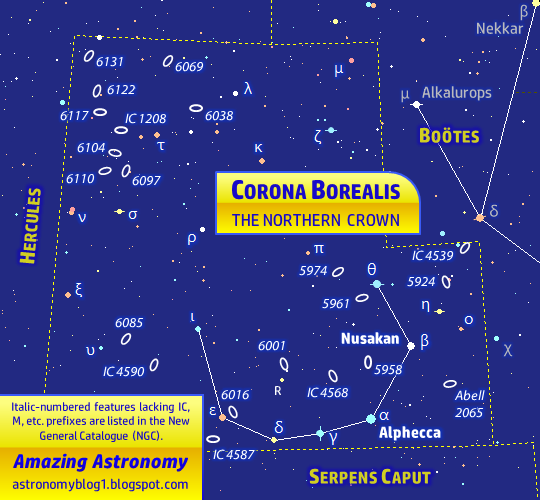
Interesting Fact: Several exoplanets — planets that are outside of our Solar System — have been discovered in Corona Borealis' region!
Monday, November 4, 2013
Corona Australis
CORONA AUSTRALIS, also known as the Southern Crown, can be visible from both the Northern and Southern Hemispheres. Compared to the constellations of Sagittarius to the north and Scorpius to the east and northeast, Corona Australis is not very bright. It is northwest of the constellation Ara and north of Telescopium. There are several deep-sky objects, like the nebula NGC 6729 and galaxies like IC (Index Catalogue) 4808. The brightest star of Corona Australis is Alpha (α) Coronae Australis with an apparent magnitude of 4.1; the star is also called Alphekka Meridiana.
Coma Berenices

Galaxies: Blackeye Galaxy, M88 (NGC 4501), M91, Pinwheel Galaxy (M99 and NGC 4524), M98 (NGC 4192), M100, NGC 4548, and NGC 4881
Star Clusters: Melotte (Mel.) 111 (open cluster) and M53 (NGC 5024)
* M stands for the Messier Catalogue; NGC stands for New General Catalogue
Wednesday, August 28, 2013
Columba

Monday, August 26, 2013
Circinus

Subscribe to:
Posts (Atom)